
Fiddle Leaf Fig Care: A Data-Driven Guide for Anxious Owners
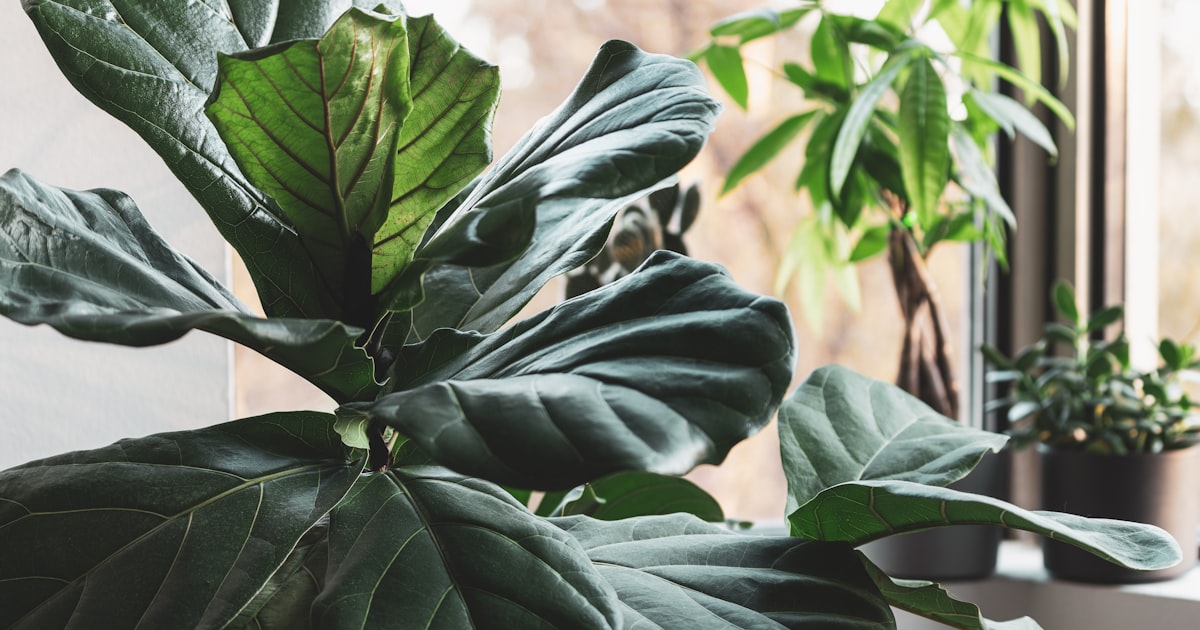
No houseplant has launched more anxious Reddit threads than Ficus lyrata, the fiddle leaf fig. Brown spots, sudden leaf drops, droopy tips, pale new growth — owners chase symptoms and rarely get clear answers.
After watching a lot of FLFs across a lot of homes, the pattern is almost always the same: the plant is responding to small environmental swings that the owner can't see. Here's what actually matters — backed by measurements instead of folklore.
Native Context Matters
Fiddle leaf figs are understory trees from the lowland rainforests of West Africa. In the wild, they grow under a canopy in warm, stable, humid conditions with dappled light — then punch through and get strong sun only once they're tall enough. That's important context because it explains almost every "picky" behavior.
They want:
- Warm and stable: 65–80°F with minimal day-to-night swing
- Humid: 50%+ RH, ideally 60%
- Bright indirect light when young, tolerating direct morning sun as they mature
- Consistent soil moisture — not wet, not bone dry, just steadily damp
The through-line in every one of those is stability. An understory tree grows up in a buffered microclimate — the canopy overhead smooths temperature swings, holds humidity up, and evens out the light. A fiddle leaf fig in your living room has none of that buffering, so it feels every change the room makes: the furnace cycling, a door opening, the sun tracking across the floor by season. That's why it reacts to shifts hardier plants shrug off, and why a continuous record of its conditions earns its keep faster on this species than almost any other.
The Missouri Botanical Garden has a good botanical profile if you want the full academic rundown.
The Brown Spot Decision Tree
Brown spots are the single most-asked FLF question. There are really only three common causes, and the location tells you which:
Brown spots at the edges/tips
Cause: Low humidity or underwatering. What sensors show: Humidity dipping below 35% for extended periods, or soil VWC dropping below 15–20% before the next watering. If you're in a home with forced-air heating, wintertime humidity often crashes into the 20s at night without you noticing.
Brown spots in the center of leaves
Cause: Root damage, usually from overwatering. What sensors show: Soil that stays above 50% VWC for more than a week at a time, or dry-down cycles that keep getting longer (a sign roots are no longer uptaking water efficiently).
Brown spots with a yellow halo
Cause: Bacterial or fungal infection, often secondary to overwatering. What sensors show: The same pattern as center spots — chronically wet soil — but now you also need to remove the affected leaves and let the soil dry substantially.
Watering: Consistency Beats a Schedule
The fiddle leaf fig's least-forgiving trait is that it punishes both ends of the watering cycle. Let it dry to a crisp and the edges brown and the newest leaves go limp; keep it saturated and the roots suffocate and rot from the inside out. What it wants is the middle: a thorough soak, then a real but moderate dry-down, then another soak before it ever reaches bone dry — steady, damp, and never extreme for long.
On a moisture chart that healthy rhythm draws a clean, repeating sawtooth. The two failure modes bend that shape in opposite directions: overwatering flattens the downslope until the line barely falls between waterings; underwatering drops it to the floor and leaves it there for days. Because PlantSense reads every 90 minutes to 5 hours, either distortion shows up in the curve well before a leaf reacts. When you identify the plant — identification runs through PlantNet — it loads care ranges tuned for Ficus lyrata rather than a generic average, and after a thorough watering you can tap "I just watered: set this as 100%" in the plant's settings so the percentage reflects your pot and mix.
The "Sudden Leaf Drop" Mystery
FLFs are famous for dropping multiple leaves after being moved, repotted, or when the seasons change. The common thread: an environmental shift the owner didn't register as significant.
A plant that was sitting at 72°F and 55% humidity in the living room doesn't care that you moved it six feet. It cares that the new spot gets a draft from the front door every time it opens, dropping temperature to 58°F for 30 seconds each time. Or that it's now 3 feet from a heating vent that creates a dry zone.
When you have continuous temperature and humidity data, the "sudden" drop stops being sudden. You can see the hundred small shocks that added up.
Acclimation is that same story stretched over weeks. A fiddle leaf fig that sheds several leaves after you first bring it home usually isn't dying — it's adjusting to a wholesale change in light, humidity, and temperature at once, and letting go of the leaves it can no longer support. The remedy is stability, not intervention: choose a spot that meets its ranges and leave it there. Watching the data settle is reassuring in that stretch — you can see the wild swings of the first week give way to a steady baseline, which is exactly what the plant waits for before it risks new growth. The same patience pays off at each change of season, when lengthening or shortening days shift the light the plant receives even though nothing in the room has moved.
Light: The One Where Intuition Fails Most
FLFs want a lot of light — more than most tropicals. But "bright" in a human sense is not "bright" to a plant. Our eyes adapt; light meters don't. Typical indoor "bright" spots might deliver 100–200 PPFD (µmol/m²/s), while an FLF wants 200–400+ for steady growth.
Cornell's indoor light guide has calibrated recommendations by species. The short version: if your FLF isn't producing new leaves every 4–6 weeks during spring and summer, it's probably under-lit, regardless of how bright the corner feels to you. PlantSense reports light as a peak lux value and charts it across the day, so instead of trusting your impression of the corner you can watch whether the daily peak actually climbs into an FLF's range.
What "Happy" Looks Like (In Data)
A thriving fiddle leaf fig, measured continuously, looks like this:
- Soil moisture: Cycles cleanly from ~60% VWC after watering down to ~25% before the next — over 7–10 days
- Temperature: Stable 68–78°F with no spikes below 60 or above 85
- Humidity: Above 45% the large majority of the time
- Light: A strong daily arc that climbs and holds through much of the day rather than barely lifting off the floor — bright indirect, with some direct morning sun tolerated as the plant matures
That's it. The FLF isn't dramatic — it's honest. It reacts quickly to conditions that other plants tolerate silently, which makes it a great barometer for the health of your whole home environment.
From Anxiety to Evidence
The reason fiddle leaf figs feel hard to keep alive is that owners are asked to interpret symptoms without any of the data that would make those symptoms make sense. Every care guide talks about humidity, light, watering — but none of them come with a way to actually measure any of it.
PlantSense does. Put a sensor in the pot, and you stop debating whether the corner is "bright enough" or the air is "humid enough." The Status tab shows the four dials at a glance, the Analytics tab keeps the history that turns a single bad day into a readable trend, and a care alert reaches you when one of them drifts out of an FLF's range. You know.